Scheduler and Coroutine Operation
poco uses a event broadcasting system to propagate signals between coroutines. The scheduler acts as the broker and passes all queued signals it has between coroutine execution.
Note
These signals are distinct from OS signals.
This messaging between coroutines is how poco implements coroutine suspension.
Coroutine Operational States
Each coroutine maintains its own internal read-only state. This indicates to the scheduler which coroutines are ready to execute and which ones are waiting on an event.
![@startuml
state Ready
state Running
state Waiting
state Finished
[*] --> Ready : create
Ready --> Running : coro_resume()
Running --> Ready : coro_yield()
Running --> Waiting : coro_yield(SIG_WAIT)
Waiting --> Ready: coro_notify(), if event matches
Running --> Finished : return
Finished --> [*]
@enduml](_images/plantuml-eccf6831b62498d82aea08e457a15c2f0be4e503.png)
Possible coroutine states and transitions.
Communication with the Scheduler
When a coroutine yields back control to the scheduler, it returns with a particular
signal the scheduler should action. These actions are found in
coro_signal.
Event Sinks and Sources
Internally, coroutines contain a single event source, and up to two event sinks. This ensures the coroutine can suspend on an event, as well as an optional timeout value (if using timeout aware APIs).
If the coroutine yields with CoroSignal::CORO_SIG_NOTIFY or
CoroSignal::CORO_SIG_NOTIFY_AND_WAIT, the scheduler must add the
notified event to its list of pending events.
Matching between event sinks and sources is done via the signal type. Most events have a 1:1 relationship between the event source and the corresponding event sink.
A typical sequence is shown below for a coroutine informing the scheduler that it is
waiting for an event. Here we show coroutine A waiting on the
CoroEventSinkType::CORO_EVTSINK_DELAY.
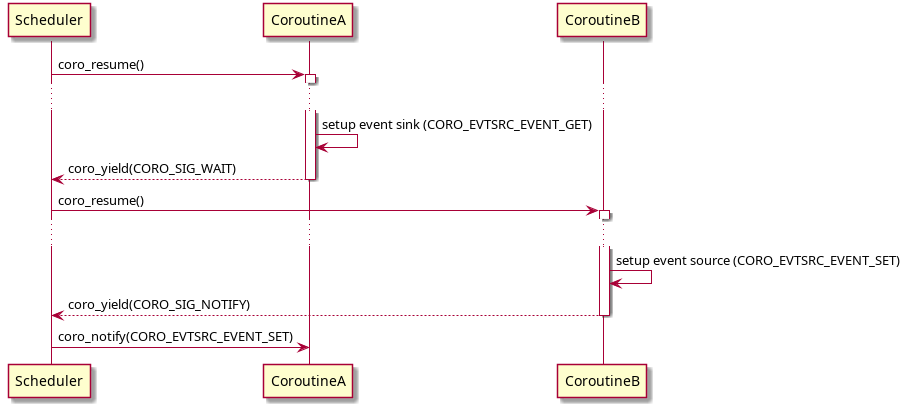
Example of coroutine suspension and unblock via the event primitive.